
Invent, Innovate, Integrate
- info@zenkaeurope.com
-
 English
English
English
 Deutsch
 Français
 Español
 Italiano
 中文
中文
 हिन्दी
 Lietuviškai
Optical Sensors - Photo Detectors - CdS Cells
Optical Sensors - Photo Detectors - CdS Cells
- Products
- Sensors, Transducers
- Optical Sensors - Photo Detectors - CdS Cells
Clear Filters
Loading products…
| Image | Part Number | Manufacturer | Description | Series | Operating Temperature | RoHS Status | Type | Output Type | Package / Case | Wavelength |
|---|---|---|---|---|---|---|---|---|---|---|

|
PDV-P9003-1 | Advanced Photonix (Luna Optoelectronics) | PHOTOCELL 23K-33K OHM 4.20MM | - | -30°C ~ 75°C (TA) | - | - | - | - | 520nm |

|
PDV-P5002 | Advanced Photonix (Luna Optoelectronics) | PHOTOCELL 12K-30K OHM 11MM | - | -30°C ~ 75°C (TA) | - | - | - | - | 520nm |
|
|
PDV-P9003 | Advanced Photonix (Luna Optoelectronics) | PHOTOCELL 16K-33K OHM 4.20MM | - | -30°C ~ 75°C (TA) | - | - | - | - | 520nm |

|
NSL-6110 | Advanced Photonix (Luna Optoelectronics) | PHOTOCELL CDS 170OHM TO-18 | - | -60°C ~ 75°C (TA) | - | - | - | - | 615nm |
|
|
PDV-P5001 | Advanced Photonix (Luna Optoelectronics) | PHOTOCELL 8K-16K OHM 11MM | - | -30°C ~ 75°C (TA) | - | - | - | - | 520nm |
|
|
PDV-P9002 | Advanced Photonix (Luna Optoelectronics) | PHOTOCELL 9K-20K OHM 4.20MM | - | -30°C ~ 75°C (TA) | - | - | - | - | 520nm |
|
|
NSL-19-018 | Advanced Photonix (Luna Optoelectronics) | PHOTOCELL CDS RES 550NM TO-18 | - | -60°C ~ 75°C (TA) | - | - | - | - | 550nm |
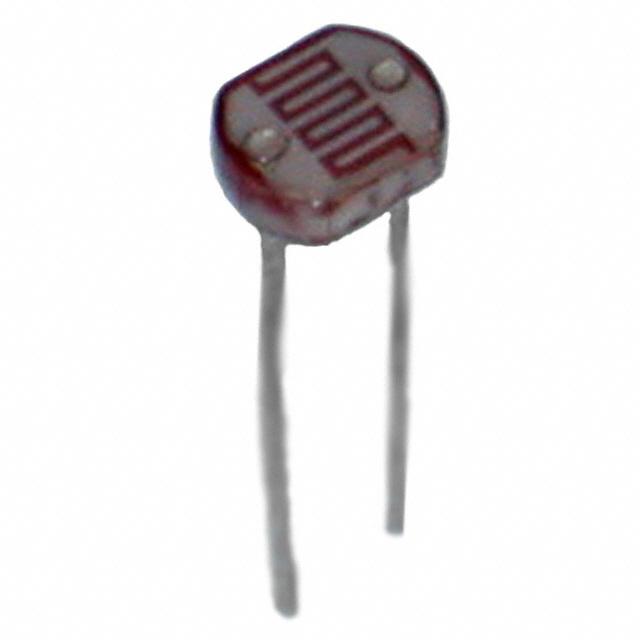
|
PDV-P2002 | Advanced Photonix (Luna Optoelectronics) | PHOTOCELL 2K-6K OHM .89MM | - | - | - | - | - | - | - |

|
PDV-P8102 | Advanced Photonix (Luna Optoelectronics) | PHOTOCELL 9K-20K OHM 5.10MM | - | -30°C ~ 75°C (TA) | - | - | - | - | 520nm |
|
|
NSL-4140 | Advanced Photonix (Luna Optoelectronics) | PHOTOCELL CDS 250OHM TO-18 | - | -60°C ~ 75°C (TA) | - | - | - | - | 550nm |
About Optical Sensors - Photo Detectors - CdS Cells
Optical sensors employing CdS (cadmium sulfide) cells are photosensitive devices used to detect and measure light intensity levels. CdS cells change resistance in response to variations in incident light, making them suitable for applications such as automatic lighting control, photographic exposure meters, and dusk-to-dawn switches. These sensors exhibit a nonlinear response to light, with resistance decreasing as light intensity increases. CdS cells offer simplicity, reliability, and cost-effectiveness compared to other light-sensing technologies. Despite their declining popularity due to environmental concerns associated with cadmium, CdS cells remain in use in certain niche applications where their characteristics meet specific requirements.